Pages

Tuesday, July 8, 2014

Doctor Know-All

Arthur Rackham

The Tale

Once upon a time there was a poor peasant by the name of Crab who drove two oxen with a load of wood into town where he sold it to a doctor for two thalers. He received his money just as the doctor was sitting down to eat. When the peasant saw how well the doctor ate and drank, his heart took a longing for the same things, and he decided that he would like to have been a doctor. He stood there for a while, and then asked if he too could not become a doctor.
"Certainly," said the doctor, "in no time at all."
"What do I have to do?" asked the peasant.
First of all, buy yourself an ABC-book, one that has a picture of a rooster up front. Second, sell your wagon and your two oxen and buy yourself some clothing and other things that doctors use. Third, have yourself a sign painted with the words 'I am Doctor Know-All' and nail it above the door to your house."
The peasant did everything he was told to do. After he had doctored a little -- but not very much -- some money was stolen from a great and wealthy nobleman. Someone told him about the Doctor Know-All who lived in such and such a village, and who must know where the money had gone. So the nobleman had his carriage hitched up, rode out to the village, and asked him if he were Doctor Know-All.
"Yes, that I am."
"Then you must come with me and recover my stolen money."
"Yes, but my wife Grete must come along too."
The nobleman agreed and had them take their places in his carriage. They rode away together.
They arrived at the nobleman's court just at mealtime, and the nobleman invited him to eat.
"Yes, but include my wife Grete," he replied, and the two of them sat down behind the table.
When the first servant brought out a platter of fine food the peasant nudged his wife and said, "Grete, that's the first one," meaning the meal's first course.
However, the servant thought that he meant, "That's the first thief," and because that is indeed what he was, he took fright, and outside he said to his comrades, "The doctor knows everything. It's going to go badly for us. He said that I'm the first one."
The second one did not want to go inside at all, but finally he had to, and when he entered, the peasant nudged his wife and said, "Grete, that's the second one."
This servant took fright as well, and went outside. It did not go any better for the third one. Once again the peasant said, "Grete, that's the third one."
The fourth one brought in a covered platter, and the nobleman told the doctor that he should demonstrate his art by guessing what it contained. It was crabs. The peasant looked at the platter, and seeing no way out of his dilemma, he said to himself, "Oh, poor Crab!"
Hearing this, the nobleman called out, "If he knows that then he must know who has the money as well!"
The servant grew very fearful and motioned to the doctor to go outside. There all four of them confessed to him that they had stolen the money. They offered to give it all to him and a handsome sum in addition, if he would not turn them in. Otherwise they would all hang. They showed him where the money was hidden. The doctor was satisfied with this, and he went back inside and sat down again at the table.
"My lord," he said, "Now I will look in my book to see where the money is hidden.
However, the fifth servant climbed into the stove in order to hear if the doctor knew anything else. The doctor leafed back and forth in his book looking for the picture of the rooster. Not finding it, he said, "I know that you are in there. Come on out."
The man in the stove thought that the doctor was talking to him, and terrified, he jumped out, saying, "The man knows everything!"
Then Doctor Know-All showed the nobleman where the money was, but he did not tell who had stolen it. Thus he received a large reward from each side and became a famous man.


Discussion Points


This is a lovely little tale about the power of appearances. Crab is nothing but a poor peasant. But all it takes is a book, some nice clothes, a fancy sign and luck to turn him into famous Doctor Know-All. He becomes something by making people believe he is something.


Let's first take a look at the objects the doctor tells him to require:
-An ABC book with a rooster on the front: I'm assuming this is a letters or alphabet book. Basically, anyone who can read would be able to tell in an instance that the book was a sham and Crab didn't know anything. But in a time when barely anyone could read (probably including Crab) it really didn't matter what book it was. Of course, the noble could probably tell what the book actually was, but no one asks questions of a man who's already considered a “Know- All”. Any book is needed to build up a reputation amongst the simple minded. Once the reputation is strong, an unexpectedly simply book would probably only add mystery to Doctor Know-All.
-Nice clothing: physical appearance is everything. If a man in peasant's clothing claimed to be a doctor the best he could hope for would be for people stick to laughing and not throw rotten vegetables his way. But once he has a nice suit and looks respectable, people will immediately treat him as such. As much as we might hate to admit it and wish people would look deeper than the clothes we wear, the fact of life is that first impressions are made by appearances. And Crab is only looking to make an impression.
-A Sign: once he has the book and the clothes, all Crab has to do is stick a sign outside his door to let people know what they are supposed to think. No one would come into Crab's house and come to the conclusion that he knew everything simply because he's wearing nice clothing. But the moment Crab tells them what they're supposed to find and what they do find matches their expectations, they have no reason not to believe him.
Of course, some extra proof is necessary in order for the sham to hold. If Crab never proved he knew anything (let alone everything), his reputation would die at once. This is probably why the tale had to point out that the noble had come after Crab had only been working for a short time. Luck had probably carried him this far, and while it can't last forever, Crab only really needed it to last until he got another opportunity.
From: "Doctor All-Knowing"
Illustrated by: Alexandra Boiger


Crab had a lot of luck in the nobleman's estate. He obviously had no idea what was going on but somehow said the right things at the right moment. I think a lot of his success has to do with his reputation. If the thieves hadn't expected him to know everything they wouldn't have interpreted his words as they had. There were probably quite a few other things he could have said that would have had the thieves thinking he had found them out. So his reputation as Doctor Know-All was in a way a self- fulfilling title. Because of the name, people believed he knew it all, and because they believed it he came off as knowing it all. The reputation supplied the proof of itself. This is the power of society's opinion. It didn't matter if Crab actually knew nothing. He managed to convince people he knew everything and reaped the reward, I wouldn't even call it unfairly.

The last thing I want to point out is Crab's character. He doesn't in any way come off as money hungry, power hungry or even as a trickster. He doesn't act out of lust or greed. He simply longs for a few simple comforts such as good food or drink and at the end he is satisfied by what he gets. He doesn't feel the need to abuse his reputation. He doesn't forget about his wife, even when a nobleman invites him over and gives her the place of honor rather than taking it for himself. Neither does he feel the need to tell the king who the thieves are. After all, they can do their trickery while he continues to do his, no need to make a big fuss out of anything or get anyone in trouble. He stays a simple man from beginning till end, as not many who move up a station in life do. This makes him a very likable character in my eyes.

What do you think? Do you like Crab as well or do you think it's not right for him to trick everyone? Does that fact that society lets itself be tricked so easily justify Crab tricking them? Or is reputation, whether it's really you or not, just part of life?

*Don't forget to vote on the poll at the sidebar!


Tuesday, July 1, 2014

The Singing Bone

I'm going to try posting a few more posts with the original tale instead of a summery. Please vote on the poll on the side to tell me what you prefer!


The Tale


Once upon a time in a certain country there was great concern about a wild boar that was destroying the peasants' fields, killing the cattle, and ripping people apart with its tusks. The king promised a large reward to anyone who could free the land from this plague, but the beast was so large and strong that no one dared to go near the woods where it lived. Finally the king proclaimed that whoever could capture or kill the wild boar should have his only daughter in marriage.
Now in this country there lived two brothers, sons of a poor man. They declared that they dared to attempt the task. The older one, who was crafty and shrewd, did so out of pride. The younger one, who was innocent and simple, did so because of his kind heart.
The king said, "In order to be more sure of finding the beast, you should enter the woods from opposite sides."

Thus the older one entered the woods from the west, and the younger one from the east.
After the younger one had walked a little while, a little dwarf stepped up to him. He held a black spear in his hand and said, "I am giving you this spear because your heart is innocent and good. With it you can confidently attack the wild boar. It will do you no harm."
He thanked the dwarf, put the spear on his shoulder, and walked on fearlessly.
Before long he saw the beast. It attacked him, but he held the spear toward it, and in its blind fury it ran into the spear with such force that its heart was slashed in two.
Then he put the monster on his back and turned towards home, intending to take it to the king.
Emerging from the other side of the woods, he came to a house where people were making merry drinking wine and dancing. His older brother was there too. Thinking that the boar would not run away from him any time soon, he had decided to drink himself some real courage. When he saw his younger brother coming out of the woods with his booty, his envious and evil heart gave him no peace.

He called out to him, "Come in, dear brother. Rest and refresh yourself with a beaker of wine."
The younger brother, suspecting no evil, went in and told him about the good dwarf who had given him the spear with which he had killed the boar.
The older brother kept him there until evening, and then they set forth together. After dark they came to a bridge over a brook, and the older brother let the younger one go first. When the younger brother reached the middle above the water, the older one gave him such a blow from behind that he fell down dead.

He buried him beneath the bridge, took the boar, and delivered it to the king, pretending that he had killed it. With this he received the king's daughter in marriage.
When his younger brother did not return he said, "The boar must have ripped him apart," and every one believed it.

But as nothing remains hidden from God, this black deed was also to come to light.
After many long years a shepherd was driving his herd across the bridge and saw a little snow-white bone lying in the sand below. Thinking that it would make a good mouthpiece, he climbed down, picked it up, and then carved out of it a mouthpiece for his horn. When he blew into it for the first time, to his great astonishment the bone began to sing by itself:

Ah, my friend, thou blowest upon my bone!
Long have I lain beside the water;
My brother slew me for the boar,
And took for his wife the king's young daughter”

"What a wonderful horn," said the shepherd. "It sings by itself. I must take it to the king."
When he brought it before the king, the horn again began to sing its little song. The king understood it well, and had the earth beneath the bridge dug up. Then the whole skeleton of the murdered man came to light.

The wicked brother could not deny the deed. He was sewn into a sack and drowned alive. The murdered man's bones were laid to rest in a beautiful grave in the churchyard.

Discussion Points

This tale has only two brothers rather than the typical three, probably in order to make a stronger comparison between the two characters.

The older brother is described as crafty and shrewd. He goes off to defeat the boar out of pride.
He needs to “drink himself some real courage” and when he sees that his younger brother succeeded his “envious and evil heart” gives him no peace until he fills his brother with drink and later kills him from behind. After that he lies about his brother's death in order to win his brother's prize.

The younger brother couldn't be more different. He is described as innocent and simple and he goes after the boar because of his kind heart. The little man gives him the spear for no reason other than that his heart is pure and good. He meets the boar fearlessly. He suspects nothing from his brother until he is killed.

This stark comparison between two archetypes is the heart of the story. To me it seems to lament the brutal realities of a world where innocence, simplicity and a kind heart are unable to survive. In most tales, the youngest brother is given aid because of a specific kind deed he does- sharing his food with a stranger or aiding someone. Here, the boy receives aid to kill the boar because he is killing the boar for selfless reasons. He is risking his life not for pride, like his older brother, and not for a prize at the end but because of his kind heart. The boar is a menace to the kingdom so he is willing to get rid of it. One may wonder that if that is the case, why didn't the boy wait for the king to offer his daughter for a wife before heading out? The answer may be two things. For one, the prize of the king's one and only daughter for marriage proves how dire the situation is. The boy might not have realized just how much the kingdom needed that boar dead until the prize was offered. Another explanation might be that the boy was worried about going alone. The two brothers accept the task at the same time. The younger brother needed the princess as a prize in order to convince his brother to come with him.

The tale states clearly that a kind, trusting heart does not mean brains. The older brother is the one that is shrewd, the younger one is simple. We see this in two instances. The younger brother is fearless while the older one needs alcohol in order to be brave enough to face the boar. Frankly, the older brother has this one right. The boar is a dangerous creature, and even though the younger brother has the spear that is meant to protect him, only a fool would put his trust completely in a black spear handed to him randomly at the side of the road by a complete stranger. While this lack of caution doesn't harm him, later on the boy is killed for exactly the same reason- too much trust. The older brother, on the other hand, has too much brains and not enough heart. He coldly plans to kill his brother by intoxicating him and abusing his trust in order to kill his from behind.

A few posts ago I differentiated between “smart” tales and “good” tales. Each of the brothers seem to represent one of these. The older brother uses his brains in order to trample everyone around him and get his prize. The younger brother receives magical aid thanks to his good heart in order to succeed on his mission. While it's hard to say which one this tale thinks it better, we can easily tell what philosophy is preferred. The thing is, both brothers end up dead. Neither receives a “happily ever after”. From the story it is clear, however, which character is “good” and which is
bad”. The younger brother is shown in a very positive light while the older one comes off more evil than the destructive, rampaging boar. So the story might be showing that both philosophies have their faults and problems that keep them from reaching their end goal, but there is a better way to live, and that is by trying to be good. The story does end with the older brother being thrown in the water and the younger one being buried in a nice cemetery. So in a way, there is more of a reward for the kind people- other people reward them and appreciate them. But smart people can only look after themselves, and if they keep on treading on others to help themselves through, society (or God, as in the story) will pay them back.

What do you think? Can a balance be found between both the brothers?

Don't forget to vote on the poll on the sidebar!


Monday, June 2, 2014

The Shepherd Boy

I still find myself debating between summarizing each tale or posting it in original form. The main pros for telling it in my own words being that it shortens the length and makes it easier to read. Also, I like being able to interpret and highlight the parts of the tale I think are interesting or important, which I feel is more similar to the traditional oral way these tales were passed along. On the other hand, the polished up, beautifully written versions of the tale leave much more room for the reader to appreciate and think about the tale on their own rather than me doing it for them. I'm going to try posting the original tale this time. If you have any thoughts or preferences about how I should post the tales I'd love to hear about it in the comments or by email!


The Tale

There was once on a time a shepherd boy whose fame spread far and wide because of the wise answers which he gave to every question. The King of the country heard of it likewise, but did not believe it, and sent for the boy. Then he said to him: "If thou canst give me an answer to three questions which I will ask thee, I will look on thee as my own child, and thou shall dwell with me in my royal palace." The boy said: "What are the three questions?" The King said: "The first is, how many drops of water are there in the ocean?" The shepherd boy answered: "Lord King, if you will have all the rivers on earth dammed up so that not a single drop runs from them into the sea until I have counted it, I will tell you how many drops there are in the sea." The King said: "The next question is, how many stars are there in the sky?" The shepherd boy said: "Give me a great sheet of white paper," and then he made so many fine points on it with a pen that they could scarcely be seen, and it was all but impossible to count them; any one who looked at them would have lost his sight. Then he said: "There are as many stars in the sky as there are points on the paper; just count them." But no one was able to do it. The King said: "The third question is, how many seconds of time are there in eternity." Then said the shepherd boy: "In Lower Pomerania is the Diamond Mountain, which is two miles and a half high, two miles and a half wide, and two miles and a half in depth; every hundred years a little bird comes and sharpens its beak on it, and when the whole mountain is worn away by this, then the first second of eternity will be over."

The King said: "Thou hast answered the three questions like a wise man, and shalt henceforth dwell with me in my royal palace, and I will regard thee as my own child."

(From “Grimm Household Tales”)

Discussion points

These discussion points are going to have more of a philosophical aspect to them because of the nature of the questions and their answers. While the popular storyline of a poor boy using his wits to change his luck in life is still present, I think the questions and answers are the main meat of the story.

The questions and answers all share something in common. They have to do with counting something vast or never ending; drops of water, stars in the sky and seconds in eternity. In return, all the answers are “hidden” in an equally impossible question for the king. Each question is more complicated and sophisticated than the last.

The First Question: This question is completely nonsensical and has no logic to it, as the shepherd-boy points out with his answer. You can't count the drops in the sea, not because of the huge amount of them, but because they are constantly changing. You can't count something ever changing, no matter what the amount. The shepherd-boy uses his answer to politely tell this to the king without insulting the question and the one asking it. Notice he doesn't answer the actual question, because there physically isn't an answer. Instead he proves why there isn't an answer in an almost humorous fashion, by giving the king the impossible task of drying up all the rivers. The king shouldn't be asking such a question unless he was able to make the situation feasible.

The Second Question: The second question makes a bit more sense. While we might know today that stars are every moment dying and being born, an innocent gaze up at the night's sky does show what appears to be a pretty constant (moving) picture. So there are a set amount of stars to count, but it is physically impossible to do so because they are so far away and there are so many of them. Again, the shepherd-boy shows this rather than answering the question itself with his sheet of white paper and all the pen points. Again, the king is asked to take an active role by seeing for himself why the task he set cannot be done. The king can have his answer- as long as he can count the points on the paper. Everyone knows the amount of points on the page aren't the same amount as the stars in the sky, but as long as they cannot even count the pen points, they cannot prove that. They are both uncountable amounts.

The Third Question- This is by far the most sophisticate question of them all. Time is not a physical
matter, so there is nothing physical hindering the boy from answering. The concept of time, and of eternity is completely abstract, the only measurements come from the mind. The boy has no excuses anymore. He has to answer the question itself. And so he does. The question is complicated because eternity is never ending, but a second is a defined fragment of time. How can you fit a fragment of time into forever? How can you split forever up into equal units? The shepherd-boy does this in two ways. Firstly he turns a second into something subjective. A second in relation to eternity is not the same as a second in relation to a minute or an hour. He can do this because the way we mark time is subjective. Human beings were the ones who decided that time is split into millennium which are split into centuries which are split into decades which are split into years which are split into months, weeks, days, hours, minutes and seconds. Humankind, with their short lives and perspective on time decided how long a second was and how many fit into minutes and how many months fit into a year. We define time using the measurement of a second. So the shepherd-boy has every logical right to decide to define a second of eternity as something completely different. Secondly, he takes a measurable amount of time long enough to make it immeasurable, and so solves the problem of using something finite to define the infinite. Technically, the time for the bird sharpening its beak once every hundred years on a diamond mountain that size is a defined amount of time. But the calculations it would take to figure out how much time that is are probably higher than anyone can reach, thus making it impossible to calculate and so practically undefined. This undefined defined amount of time is the first second of the infinite, undefined eternity.

On a slightly unrelated point, I very much like the king character in this specific story. There's no double sided sword in his offer to the boy. He's willing to adopt him and give him a chance at a better life without any personal gain. Perhaps he has no children of his own or none he wishes to inherit the kingdom to. Either way, he appreciates wisdom and is willing to reward it, there's no hints to any malicious behavior as is often found in fairy tale kings that give poor boys the chance to improve their lot in life, and that ranks him pretty high in my books.

The interesting thing about all these questions is that they don't demand a great amount of knowledge in order to answer them. They are all purely logical and ask for innovative thinking rather than lots of information. Logic is where shepherd-boys can match minds with the king himself and come up on top. It's a story that shows that rank does not decide everything about a person. Everyone can answer great questions about life, the universe and everything if they aren't afraid to use their minds and take a chance.


Wednesday, January 22, 2014

Death's Messengers

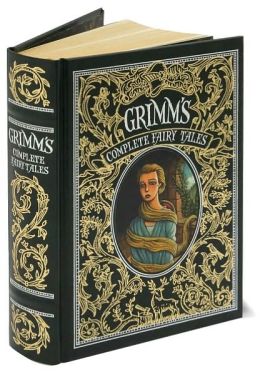
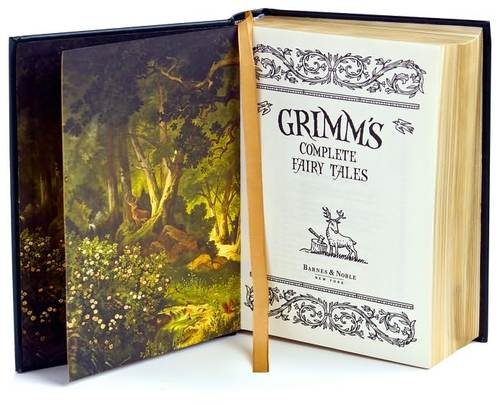
I have recently become the proud owner of Barnes and Noble's stunning leather-bound "Grimm's Complete Fairy Tales", which suffice to say makes me very very very happy. The six pages of table of contents should give you a good idea of how many tales there are in it. There are countless beautiful illustrations as well, and the cover and inside flag are all gorgeous. It's a huge upgrade from my previous edition of fairy tales, which was a plain green paperback Penguin's Classics, and much more fun to read, so hopefully it will inspire more consistent blog posts. I'll post some images to make you all jealous before I get back to business: 


The Tale

This story takes place in ancient times. A giant is traveling on a great highway when a man jumps up in front of him and demands that he halts. The giant, of course, has no interest in listening to a “creature whom I can crush between my fingers,”. The figure promptly introduces himself as Death, and though Death might be slightly harder to crush between fingers, the giant is still unwilling to listen to him. The two struggle, and after a long and violent battle, the giant wins and strikes Death to the ground.

Death lays there, conquered and weak (but alive), worried that the world "will get so full of people that they won't have room to stand besides each other.” Luckily for Death and the world, a young, strong and healthy man finds Death and in an act of compassion, gives him a strengthening draught. Once he is feeling better, Death asks the man if he realizes who he just helped. He does not know Death, and Death hurries to explain that; “I spare no one, and can make no exception with thee.” Instead he shows his gratitude by promising the man that he will not to come to him unexpected, but will send a messenger before he takes him away. The man is content with having a warning before he dies, and continues on with his life, happy and living without a thought.

"But youth and health did not last long, and soon came sickness and sorrows, which tormented him by day, and took away his rest by night.” But the man knows he will not die without a warning, so he does not fear the sickness will bring an end to his life. Indeed, soon enough he is once again well enough to live merrily.

fairytalebedtime.com
Then one day, he feels a tap on his shoulder and turns to see Death standing behind him. Death informs him his hour has come and bides him to follow. The man gets angry and tells Death that he is breaking his promise, for no messenger had come to warn him. Death immediately corrects his mistake. He had sent a messenger. Several in fact. Fever, dizziness, pain, “and besides all that, has not my own brother Sleep reminded thee every night of me?”
For this the man has no answer, and he yields to his fate and leaves with Death.


Discussion Points

Death. It drifts over us all our lives, dropping in for a short visit every once in a while in case we ever try to forget it. It's the great mystery of the unknown, the looming fear at the end of the road that we are constantly getting closer to if we like it or not. One of the scarier aspects of death is in the unknowing. It's the looming threat that we never know exactly when and how it will hit us. It can happen at any point to any one. Though sometimes knowing is actually worse than not knowing, as I’m sure many terminal patients will tell you. I feel as though the only time death can truly be treated with some acceptance is at a ripe old age, when you've managed to live your life to the fullest and it holds no more promises.
Considering all this and more, this tale does a splendid job when it comes to tackling the one undeniable truth of the universe with an attempt to calm some of the fears it naturally arouses.

The tale seems to deal with a few basic issues concerning death. Mostly it seems to be trying to explain it and lessen the fear of it. They're connected of course. Naturally, once we understand something, it is easier not to fear it. We can find elements of both throughout the story.


Death's character is even further removed from any evil image when he wishes to repay the man for helping him. He is capable of gratitude, and of mercy, but only to a certain degree. The fact that Death can spare no one, not even the one who aided him when he needed it, even though he obviously wishes he could, once again strengthens the necessity of death.

The tale also gives quite a few pointers that can help someone get over the fear of death. Sleep is introduced as the brother of Death, a similar experience that everyone goes through. No one fears falling asleep, and so there is also no reason to fear Death. The comparison is made very clear by one line; “Dist thou not lie by night as if thou wert already dead?”

(Aurian Redson
http://aurianredson.blogspot.co/2011/04/away-in-woods.html)
A much more subtle tip is given in the form of the man's sickness. He does not die from this 'messenger of Death'. Indeed, he does not even recognize there is a message being passed. But it is thanks to this very fact that the man manages to pull through his illness. His certainty that he will not die then because he had not yet received his message is probably the very thing that pulled him through and gave him the willpower to survive. The fact that the man recovers and lives longer even though Death's messenger popped by reminds us all that sometimes a bit of hope goes a long way.

But the story does not hide from the final truth- death happens, to everyone. It's a part of life that no matter how brave, kind or strong we are, we can't escape it. But it does not have to be viewed as a punishment, nor does it have to be feared.

The first part of the story, however, leaves a powerful message. Death himself is beaten and left helpless by a giant. Because it's made perfectly clear that no one can escape death, I can't see the giant as proof that anyone strong enough can defeat it. Rather, I think the giant, as a mythological creature, might be there to remind us all that there IS a way to beat death, in the broader sense of the word. If someone is remembered even after his body has turned to dust, doesn't his memory, in a way, escape the confinements of death? If someone makes some great contribution to society, doesn't part of him, in a way, live on as long as he keeps making an impact?The giant himself is proof of this, the long dead creature from ancient times which the tale brings back from the dead in a tale in order for him to fight Death itself. And while Death can never be completely destroyed, he can be conquered in different, metaphorical ways.

In short, I feel as though this tale does a fine job in tackling a child's fear of death and making the fact of life slightly more tolerable. What say you?


Thursday, December 5, 2013

Pee-Wit

Here's another fairy tale that seems to take all the morals we hold dear (such as being a good person), picks them up, looks at them and says 'nah, we think everyone should do the opposite instead'.
The Lapwig or Peewit
http://chestofbooks.com/gardening-horticulture/Animal-Pests/The-Lapwing-Or-Peewit-Vanellus-Cristatus-Or-Vulgaris.html#.UqDRf9IW2So

The Tale

There was once a poor countryman named Pee-Wit. One day he hears someone calling out his name. He turns and finds a bird, which, incidentally, is called a Pee-Wit and “like a cuckoo, always keeps crying out his own name”. Our Pee-Wit, however, thinks the bird is mocking him and throws a stone in it's direction. The stone misses and hits one of his oxen on the head, killing it instantly. Pee-Wit is not quite sure what to do with his other ox, as he can't plow his field with only one, so he decides to kill it as well and sell both the tans to the tanner for as much as he can get. When he reaches the tanner's house, he sees through the window that Mrs. Tanner is hiding a male friend of hers in an old chest, as though afraid that someone might see him. Pee-Wit enters the house and offers to sell his two hides for the old chest. When the tanner arrives, he agrees at once to such a good bargain, and his wife can hardly do anything about it. So Pee-Wit heads off with a man in a chest in his cart, and refuses to let the man out until he pays him one thousand dollars (yes, it says dollars).

Pee-Wit returns home, very happy and very rich, and manages to make his neighbors very suspicious. They take him before the justice to prove he came by the wealth honestly (which he didn't), and he lies and tells them he got so rich by selling his hides to the tanner for one grand. All the townspeople immediately decide to do the same, and the justice's maid is the first to go and get laughed at by the tanner. The townspeople are now very not happy, and they decide to do Pee-Wit some mischief while he works in his garden. Pee-Wit finds out about their plan, but luckily for him, he was “plagued by a sad scold for his wife” and now had a chance to get rid both of the irksome townspeople and his wife! So he convinces her to dress up as him and work in the garden. The townspeople see her, think it's Pee-Wit, and throw a stone at her (“harder perhaps than they meant”), and it kills her. Pee-Wit at least has the decency to be “rather sorry at that” before he thinks of a way to make a profit off his wife's death; He then takes his wife's body, dresses her in her own clothes and sits her by the roadside with a basket of fruit. A Rich noble rides past and wishes to by the fruit. When the (dead) woman doesn't respond to the servant's request, the servant pushes her and she falls back into a pond. Pee-Wit immediately runs up and cries that the noble killed his wife and threatens to have him tried. The noble immediately offers to give Pee-Wit his coach,horses and servants. Pee-Wit takes a while to be appeased before accepting.

The neighbors wonder greatly when they see the fancy coach and horses and wonder even more greatly when they see a man they thought dead step out of it. They become vexed when he tells them the story (I think I would be more disgusted, personally, but each to their own) and tie him into a cask which they plan to throw in the lake. On the way to the lake, they stop by an alehouse and go inside to get a drink. Pee-Wit, tied in his cask outside, hears the baa-ing of sheep and calls to the shepherd. Pee-Wit manages to convince the shepherd that the townspeople put him in the cask when he refused to be burgomaster (chief magistrate). The shepherd, who wants to be burgomaster, switches Pee-Wit and climbs into the cask. When the townspeople come back he shouts; “I will be burgomaster now”. Naturally, the townspeople ignore this and throw him into the lake.

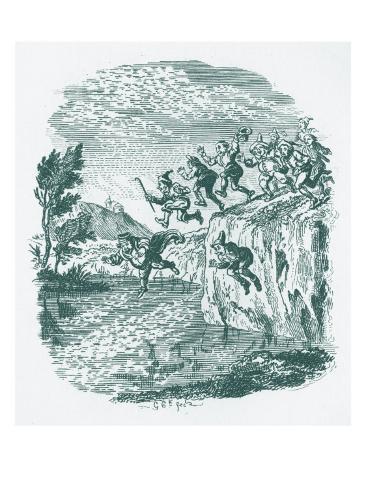
The townspeople get another shock when they see Pee-Wit heading towards them with a flock of sheep. He tells them all that the lake they threw him into was enchanted and had hundreds of thousands of sheep grazing at the bottom. The townspeople decide to dive into the lake and get some sheep themselves. They jump into the lake, see the white fluffy clouds reflected in the water, mistaken them for sheep and try to dive down to the bottom. Pee-Wit returns home, finally content with what he has, and “leaving them (the townspeople) to find their flocks by themselves as best they could”.

Pee-Wit
George Cruikshanks

Discussion Points

Well, put it this way, I think it is safe to say that stereotypical fairy tale virtues such as kindness, selflessness and honesty pretty much don't exist here. This might not be new to many of you, but seeing as this is the first time I’m reading any tales but the well known ones, I’m starting to realize something surprising. Not all fairy tales hold by the same morality code that;
a. We do
b. We expect these educational stories to.

Basically, the reason some virtues can be considered stereotypically the ones that fairy tales try to pass on is because these are the ones our generation has chosen to remember. We tell the stories that praise innocence, beauty (both inside and out), purity, true love and goodness. But we completely ignore the tales that praise completely different sorts of virtues, such as intelligence, wit, creativity and self preservation. Remember Hans, the nice, empty-headed boy who through is foolishness ended up with nothing? Then there's the Wonderful Musician who cruelly tricked the animals and still got his happy ending? And what about that strange ending of 'The Turnip', where the youngest brother tricks the unsuspecting student unnecessarily in order to escape? In all these stories, the ones with a happy ending aren't the ones who are nice- they're the ones who are smart and creative, even if that means that they treat other people unfairly. The villains here aren't evil- they're stupid. Basically, these tales run on a completely different morality code than the ones we're used to, one where the most important person is you rather than everyone around you. It's alright to push others down in order to push yourself forward. To make things easier, I’m going to call the first type of tales the 'good' tales, and the second type the 'smart' tales.

Pee-Wit is a great example to this. He as good as causes his own wife's death and then uses it to further build his wealth. The most important thing to him seems to be to make money, and the tale agrees with that and shows us this by giving Pee-Wit his happy ending and making his enemies fail and come out stupid. Pee-Wit does not seem to have a moral compass that we today would agree with. He lies to get out of trouble, tricks everyone around him for his own gain, plays with others' lives and their deaths and would probably be on a few 'most wanted' lists if he was alive today. And yet the tale seems to want us to take example from this.

It's interesting to note how Pee-Wit's journey begins; when he believes he is mocked, his life finally becomes too much for him and he takes matters into his own hands. This, I think, may be the key to helping us accept the twisted morality that continues throughout the tale, and through other 'smart' tales. Pee-Wit starts off as a poor countryman. At the time the tale was told, there were probably a lot of poor countrymen. It was a different day and age where most the money and power was held by the elite few while most people had almost nothing. In that day an age, a tale where someone who had nothing manages to use his wits in order to better his life was probably more important to some people than tales of honest virtues and dependence on chance to change your fate. 

Cinderella- type tales were always present as well, which gave people two alternative ways to deal with the hardships of life;
a. You could be a good person and hope that someone would consider you worthy enough to grant you a chance at a better life. Most these tales involve an element of magic: fairy godmothers, mysterious helpers, advice from talking creatures, etc. Basically, they were more hopeful than realistic. They told people that it didn't matter how bad your life was, because being a good person is much more important.
b. You could take matters into your own hands, try to change your own fate, use your own personal skills to make a difference. While this option was much more feasible, there is a price to pay: in the battle to help yourself you will end up forgetting about everyone around you.

What would you choose? Would you rather be a good, decent person or a successful one? The answer might lead us to a speculation that could explain why the 'good' tales are more popular today than the 'smart' ones. In a world where the rich and powerful are the ones who worked their way up to the top and trampled on others to get there (rather than the ones who were born to it), the 'smart' tales seem to have been a bit too successful, with a very high cost. If our capitalistic lifestyle has taken these types of tales a bit too seriously, doesn't it make sense that we would try to balance that out by putting other virtues in the spotlight? If everyone is so intent on being successful, there is no longer a need for a tale that teaches us the need to be successful. But we do need some stories to remind us that there are other things that are important as well.

What do you think?

Thursday, November 14, 2013

The Crows and the Soldier

Three Crows

The Tale:

There was once a soldier who managed to save up most his money by not spending all of it on food and drink like the others did. He had two comrades who wanted to rob him of his hard earned money, but acted as though they were his friends. They finally manged to convince him to leave the town with them and find a home of his own. Halfway through the journey, they use a disagreement as an excuse and jumped on him, beating him until he was blind. They then take his money and tie him to a gallows tree and leave him there, presumably to die. The blind soldier feels the beam of wood he is tied to and believes it is a cross. Thankful that they left him this small mercy for now “Heaven will guard me”, he begins to pray.

When night comes, the soldier hears a fluttering sound which turned out to be three crows that then land on the tree. They begin to talk and share with each other (and unknowingly, with the soldier as well) three important tidbits of information:
  1. The princess is ill, the king has vowed to marry her to anyone who finds a cure, but the only cure is to burn a nearby (yonder) flower to ashes and give it to her to swallow.
  2. That night, healing dew will fall from the heavens that if a blind man washed his eyes with it, he would be able to see again.
  3. "The flower is wanted by for one, the dew is wanted but for few,” but there is a drought in the land, and no one knows that if you take away a large stone from the market place, there will be a spring with plenty water for all.
Overjoyed at what he had just heard, the blind soldier fights against his bonds until he is free. He then washes his eyes with dew from the grass and regains his sight. After that he finds the nearby flower, burns it, gathers up the ashes, and heads off towards the castle.

After he cures the princess, the king tries to stop the shabby looking man from marrying his daughter by declaring that “whoever wants to have the princess for a wife, must find enough water for the use of the town, where there is this summer a great dearth”. Luckily for the soldier, this problem could also be solved using the crows' convenient information, and he immediately moves the stone and marries the princess.

But a happy ending isn't a happy ending until the villains of the story are punished, so next we hear of the day when the soldier meets his wicked comrades again. They do not recognize him so he introduces himself and explains all that had transpired, and that “Heaven has defeated your wicked wishes, and turned all the mischief which you brought upon me into good luck.”
They fall at his feet, begging for forgiveness, and of course our kindhearted protagonist not only forgives them, but also brings them to the palace and gives them food and clothes.

The comrades remember what he said about the crows and decide to try their luck, so they steal away and sit by the gallows. The crows indeed to come and share information with each other- but the information is the realization that someone must have overheard them speaking. They plan to search to see if they can find someone nearby to punish him for overhearing. They find the comrades and attack them until they are blind and dying. The soldier wonders where his comrades have gotten to, and sets out to search for them. He “found them where they lay, dreadfully repaid for all their folly and baseness.

*Read the original tale here


Discussion points:

There are a few points of interest in this tale:

*The comrades were planning on stealing his money all along. If so, why did they feel the need to wait for the right excuse to jump on him? Why did they wait for a disagreement on the roads instead of attacking him the moment they were far enough away from town? Could they perhaps have been hoping they could get what they wanted without attacking him but the disagreement made them realize there was no chance of that? Maybe they were unwilling to hurt him so they pushed it off for as long as they could, but then why did they beat him until he was blind after? If he became blind from the beating, they obviously beat him far more than they had to. Could this be a small attempt of the story to see a different side to its villains? Or perhaps they had simply been waiting for the opportune moment?

*Now for the question of the power of faith. The soldier prayed because he thought he was tied to a cross. He attributes his escape and good fortune to those prayers. But the story also points out that he was not actually tied to a cross, but to a gallows tree. So in a way his fortune truly attributed to his prayers (or his hope for escape, for the less religious between us) and not to any holy item. I wonder if he would have been so lucky if he had not made the mistake of thinking he was by a cross and praying. Perhaps he would not have heard the crows at all, or he might have heard them, but not thought he had any chance of succeeding so he would not have listened. I feel as though without his faith, his belief that if he prayed hard enough, something would protect him,
the tale would not have had such a happy ending. I think that is something everyone can learn from. You must have some faith in the impossible in order to have the courage to make the impossible happen.


*This fairy tale chooses to keep the soldier as the perfectly good, pious man. He wonderful traits are described throughout the story. We are told of the good way he handles his money, his great faith and most importantly, the way he treats those who harmed him. He not only forgives his comrades who betrayed him entirely, he even takes them into his home and feeds and clothes them. But of course the story itself can't let the bad ones go unpunished, just as it can't let any act of vengeance dirty the purity of the protagonist. So it finds a way to make the comrade's own greed, the cause of their evil act, the cause of their undoing as well. The punishment is fitting, and the soldier remains innocent, so in this story at least it is quite clear who is bad and who is good. 

(I couldn't find any images again. That's the problem with dealing with less known fairy tales, isn't it?)

Monday, October 14, 2013

The Three Languages

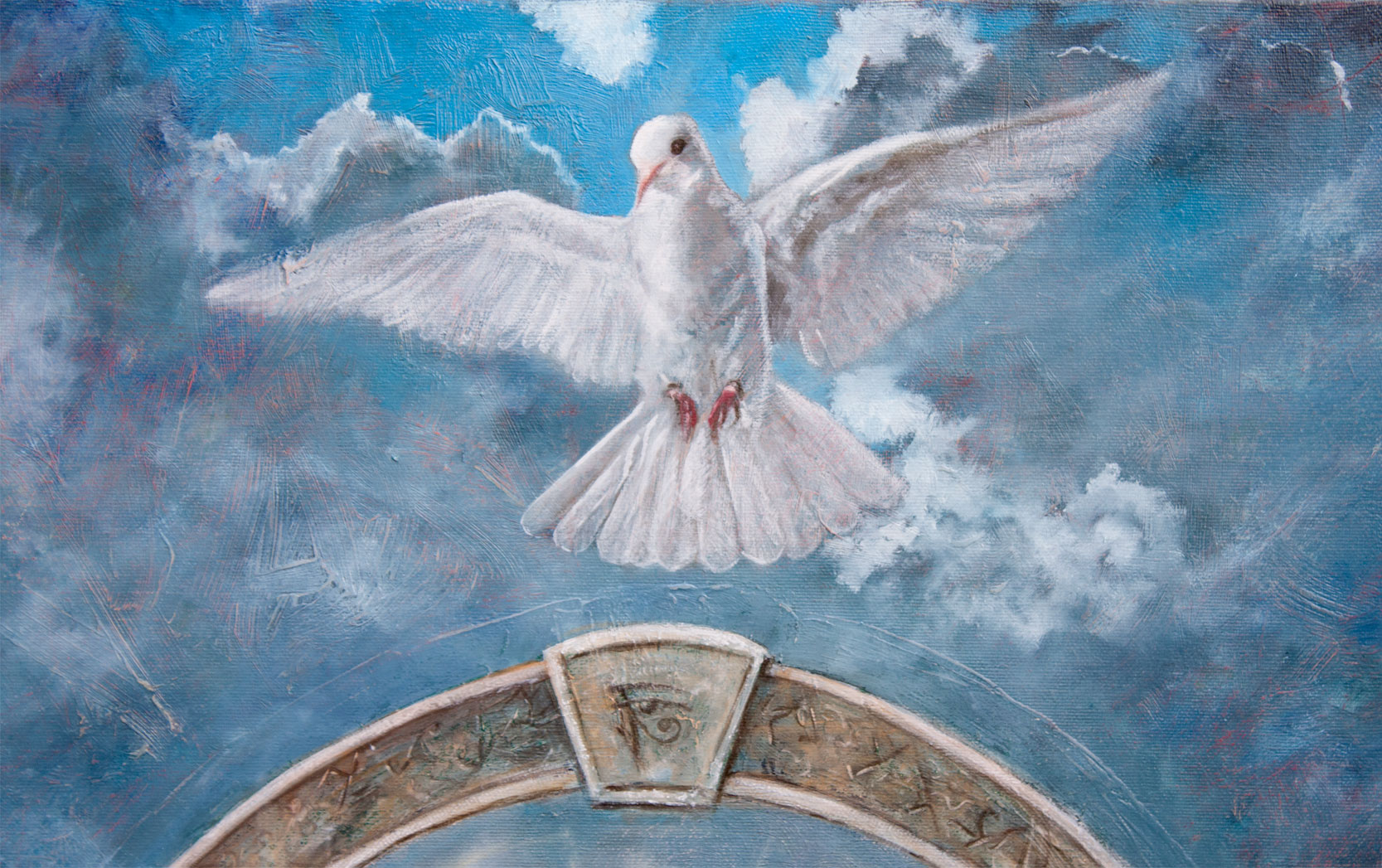
"Oil Painted Dove Detail"
Darko Topalski

The Tale

There was once an old count in Switzerland who had one son who was stupid and couldn’t learn anything. The father decides to try his best to educate his son and three times sends him away for an entire year to learn with a celebrated master. After each year the son tells his father what he has learned:
http://freepages.misc.rootsweb.ancestry.com/~blinkofamily/
The first year he learned the speech of the dogs.
After the second year he understood the language of birds.
At the end of the third year, he knew what frogs said as well.
His father is very unhappy with the way his son wasted his education and immediately declares that he is no longer his son and proceeds to order the village people to take the boy to the woods and kill him. The villagers take pity on the boy and cut out the eyes and the tongue of a deer to bring back to the count as proof that his son was dead.

The poor boy wanders around until he finds a fortress where he begs to spend the night. They offer him to spend the night in an old tower which was infested with wild dogs who terrorized the whole town and even devoured a man once. The youth merely asks for some food to give the dogs and goes to the tower without fear and the dogs do not harm him. The next morning, he informed the lord of the fortress that the dogs had told him (in their own language, which he speaks) that they are bewitched to watch over a treasure in the old tower. They also tell the boy how to break the enchantment and find the treasure. The lord promises to adopt the boy as his own if he breaks the curse and retrieves the treasure, which the boy obviously does.

"Frog Swamp"
doredor (deviantart)
After some time, the youth decides there is nothing he wishes for more other than to travel to Rome. On the way, he passes through a marsh where he hears frogs croaking. When he hears what they are saying, he becomes very sorrowful and sad (and no, we do not know what it is they said). When he arrives at Rome, he finds the pope has died and the people are desperately searching for a new one. They agree that they will choose someone whom will be distinguished by some “divine and miraculous token”. The young count enters the church and two white doves land on his shoulders. The people immediately see this as a token from above and asked him to be the pope. The youth is unsure whether to accept or not, but the birds whisper in his ears and convince him to agree. “Thus was fulfilled what he had heard from the frogs on his way, which had so affected him, that he was to be his Holiness the Pope.” He was anointed and consecrated at that very moment and has to immediately sing mass, which he has no idea how to do, but the birds once again aid him by telling him the words.

*Read the original tale here

Discussion Points

I’d rather focus less on the Christian aspects of the tale, seeing as I do not know so much about it so I’d rather not complicate matters. If anyone has any other insights due to more knowledge, feel free to share them in the comments below J

Parenthood- One way to interpret the story is as a tale dealing with parent- child relationships. The boy starts off as the unwanted, stupid son of the count who gets so fed up with his stupidity that he disowns him and refuses to call him his son any longer. So the boy moves from being an unloved son to an orphan. After that, the boy is ‘adopted’ by the lord of the fortress who sees his worth after he breaks the enchantment and brings back the treasure. So the boy becomes a loved son. Then, the boy proceeds to become the pope, the figure who is considered the holy father of the Roman Catholic Church and its worshippers. So the boy goes through a very interesting development: from hated son to orphan to loved son to father of many. He is hated because of a trait from birth- his stupidity. His father throws him out due to his actions- his failure to fix his stupidity by learning. He gets adopted once again also due to his actions, and even more so, thanks to his special skills and personal interests (assuming that if he learned animal speech for three years when he wasn’t supposed to, it is something that interests him). After he is accepted and loved thanks to these skills, he can then use those same skills to take a step forward- and become a father. It’s also interesting to note that the boy was horrified at first by the idea of being a father and it takes much convincing before he accepts the responsibilities. Perhaps he is too traumatized by the way his father didn’t accept him as his son and therefore wants nothing to do with parenting of any sort (including the spiritual kind, forgetting for a moment the pope’s place of power). It is only after the birds, using the very same speech due to which his father kicked him out but the also thanks to which the lord adopted him, he was able to overcome the traumas involved in parenting and accept the role.

"The Great Ballet"
Pierre Leduc
The order of the languages: I think this is the first fairy tale I have come across in which we are given three details in a different order from the one they appear in later on in the tale. The boy first learns the speech of the dogs, then of the birds and finally of the frogs. Basing off what usually happens in fairy tales, I would assume that the knowledge of each language would be relevant in that order- first he would meet the dogs, then the birds and after that the frogs. But this is not the case: the meeting and the information gleaned from the frogs comes before the birds’ aid.
The only answer I can think of (while giving credit to the storyteller that they did not simply make a mistake) is that he learns the speeches in the order that would be most useful to him. The frogs are definitely the least useful creatures- we don’t even know what they said until later on in the story. The only question is, if this theory is true, why are the dogs considered more helpful than the doves? After all, the doves help him become the pope- what could be more important than that?
I think the answer is that the dogs did something much more important than give the boy the power of the pope. They were the first to accept him after his father kicked him out (by wagging their tails when he came to them) and helping him win his new father’s love and in a way restoring his confidence in himself and his ability to be accepted.


So, what do you think? Am I making a mistake in trying to take the moral of the story away from Christianity in a story that is obviously Christian? Or is there room for a universal idea to hide under the cloak of a specific culture? 


*I couldn't find a single tale-related image so I did the best I could.