 |
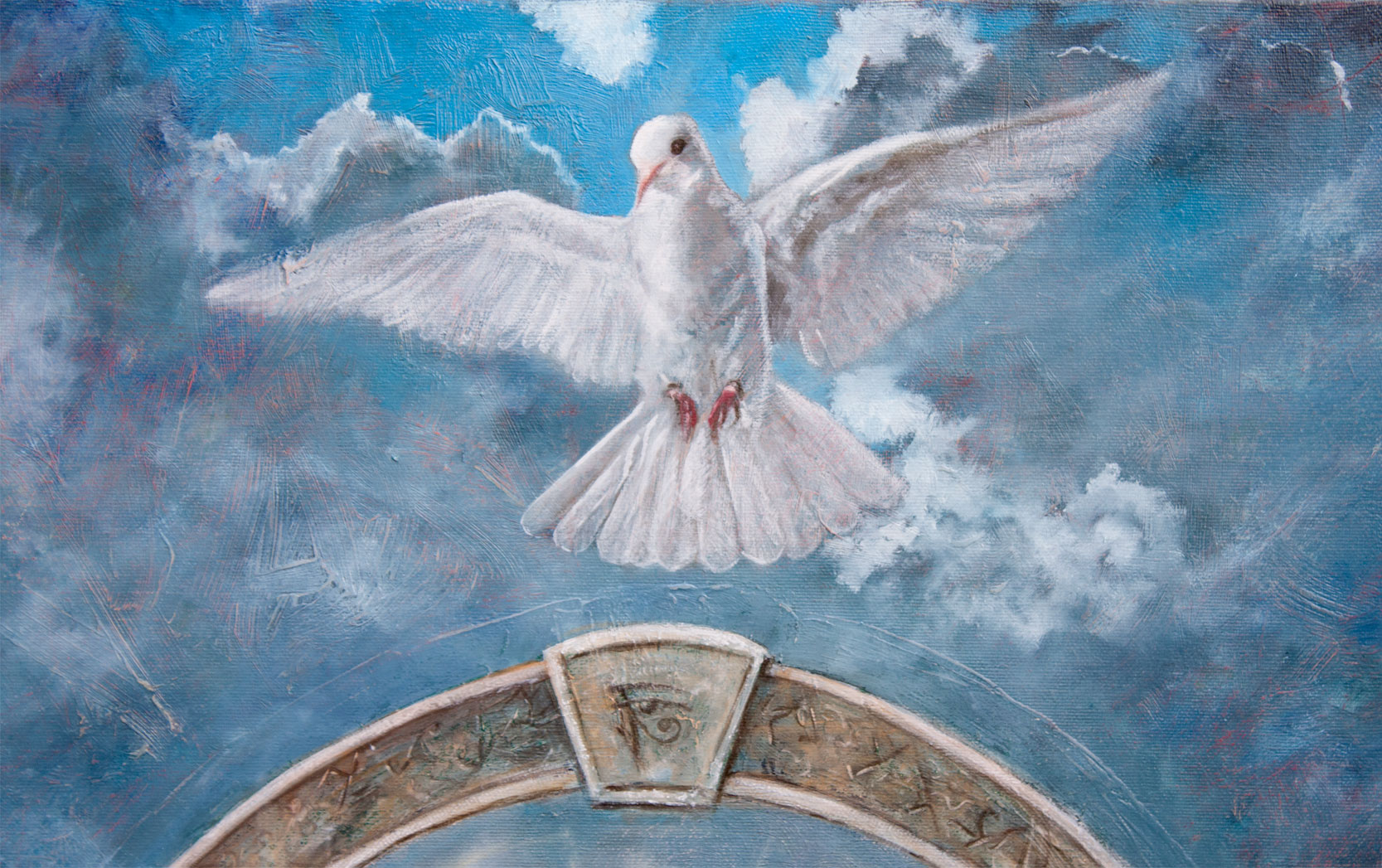
| "Oil Painted Dove Detail" Darko Topalski |
The Tale
There was once an old
count in Switzerland
 |
| http://freepages.misc.rootsweb.ancestry.com/~blinkofamily/ |
The first year he
learned the speech of the dogs.
After the second year
he understood the language of birds.
At the end of the
third year, he knew what frogs said as well.
His father is very
unhappy with the way his son wasted his education and immediately declares that
he is no longer his son and proceeds to order the village people to take the
boy to the woods and kill him. The villagers take pity on the boy and cut out
the eyes and the tongue of a deer to bring back to the count as proof that his
son was dead.
The poor boy wanders
around until he finds a fortress where he begs to spend the night. They offer
him to spend the night in an old tower which was infested with wild dogs who
terrorized the whole town and even devoured a man once. The youth merely asks
for some food to give the dogs and goes to the tower without fear and the dogs
do not harm him. The next morning, he informed the lord of the fortress that
the dogs had told him (in their own language, which he speaks) that they are
bewitched to watch over a treasure in the old tower. They also tell the boy how
to break the enchantment and find the treasure. The lord promises to adopt the
boy as his own if he breaks the curse and retrieves the treasure, which the boy
obviously does.
 |
| "Frog Swamp" doredor (deviantart) |
After some time, the
youth decides there is nothing he wishes for more other than to travel to Rome Rome
*Read the original tale here
Discussion Points
I’d rather focus less on the Christian aspects of the tale, seeing as I do not know so much about it so I’d rather not complicate matters. If anyone has any other insights due to more knowledge, feel free to share them in the comments below J
Parenthood- One way to interpret the story is as a tale dealing with parent- child relationships. The boy starts off as the unwanted, stupid son of the count who gets so fed up with his stupidity that he disowns him and refuses to call him his son any longer. So the boy moves from being an unloved son to an orphan. After that, the boy is
‘adopted’ by the lord of the fortress who sees his worth after he breaks the
enchantment and brings back the treasure. So the boy becomes a loved son. Then,
the boy proceeds to become the pope, the figure who is considered the holy
father of the Roman Catholic Church and its worshippers. So the boy goes through
a very interesting development: from hated son to orphan to loved son to father
of many. He is hated because of a trait from birth- his stupidity. His father
throws him out due to his actions- his failure to fix his stupidity by
learning. He gets adopted once again also due to his actions, and even more so,
thanks to his special skills and personal interests (assuming that if he
learned animal speech for three years when he wasn’t supposed to, it is
something that interests him). After he is accepted and loved thanks to these
skills, he can then use those same skills to take a step forward- and become a
father. It’s also interesting to note that the boy was horrified at first by
the idea of being a father and it takes much convincing before he accepts the
responsibilities. Perhaps he is too traumatized by the way his father didn’t
accept him as his son and therefore wants nothing to do with parenting of any
sort (including the spiritual kind, forgetting for a moment the pope’s place of
power). It is only after the birds, using the very same speech due to which his
father kicked him out but the also thanks to which the lord adopted him, he was
able to overcome the traumas involved in parenting and accept the role.
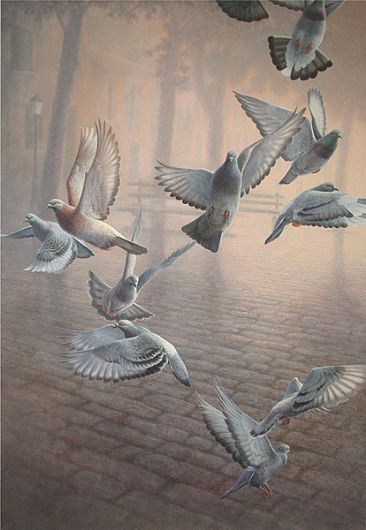 |
| "The Great Ballet" Pierre Leduc |
The order of the languages: I think this is the
first fairy tale I have come across in which we are given three details in a
different order from the one they appear in later on in the tale. The boy first
learns the speech of the dogs, then of the birds and finally of the frogs.
Basing off what usually happens in fairy tales, I would assume that the
knowledge of each language would be relevant in that order- first he would meet
the dogs, then the birds and after that the frogs. But this is not the case:
the meeting and the information gleaned from the frogs comes before the birds’
aid.
The only answer I can
think of (while giving credit to the storyteller that they did not simply make
a mistake) is that he learns the speeches in the order that would be most
useful to him. The frogs are definitely the least useful creatures- we don’t
even know what they said until later on in the story. The only question is, if
this theory is true, why are the dogs considered more helpful than the doves? After
all, the doves help him become the pope- what could be more important than
that?
I think the answer is
that the dogs did something much more important than give the boy the power of
the pope. They were the first to accept him after his father kicked him out (by
wagging their tails when he came to them) and helping him win his new father’s
love and in a way restoring his confidence in himself and his ability to be
accepted.
So, what do you think?
Am I making a mistake in trying to take the moral of the story away from Christianity
in a story that is obviously Christian? Or is there room for a universal idea
to hide under the cloak of a specific culture?
*I couldn't find a single tale-related image so I did the best I could.

I enjoyed the story very much. I like your point about the order that the boy learned the languages and their importance in the end of the story. I wanted to add also a connection between the dogs and the boy.
ReplyDeleteDogs in general are loving creatures and the boy when he meet the dogs he wasn't loved. After he was able to tame them and find the treasure, he was loved.
Can't wait to read more
Miriam :))
Thanks Miriam :) Good point about the dogs!
ReplyDelete