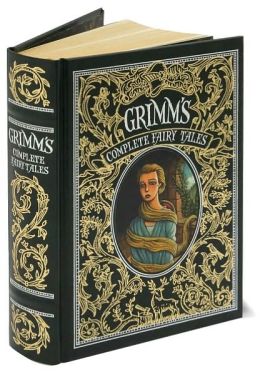
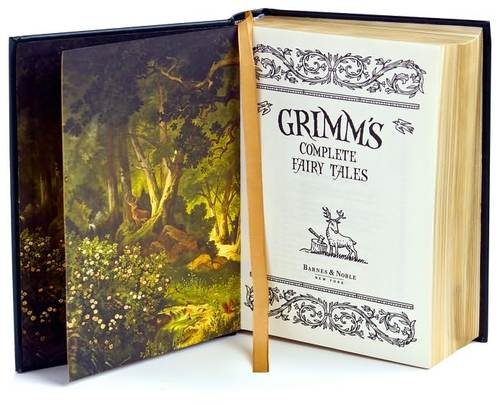
I have recently become the proud owner of Barnes and Noble's stunning leather-bound "Grimm's Complete Fairy Tales", which suffice to say makes me very very very happy. The six pages of table of contents should give you a good idea of how many tales there are in it. There are countless beautiful illustrations as well, and the cover and inside flag are all gorgeous. It's a huge upgrade from my previous edition of fairy tales, which was a plain green paperback Penguin's Classics, and much more fun to read, so hopefully it will inspire more consistent blog posts. I'll post some images to make you all jealous before I get back to business:
The
Tale
This story takes place
in ancient times. A giant is traveling on a great highway when a man
jumps up in front of him and demands that he halts. The giant, of
course, has no interest in listening to a “creature whom I can
crush between my fingers,”. The figure promptly introduces himself
as Death, and though Death might be slightly harder to crush between
fingers, the giant is still unwilling to listen to him. The two
struggle, and after a long and violent battle, the giant wins and
strikes Death to the ground.
Death lays there,
conquered and weak (but alive), worried that the world "will get
so full of people that they won't have room to stand besides each
other.” Luckily for Death and the world, a young, strong and
healthy man finds Death and in an act of compassion, gives him a
strengthening draught. Once he is feeling better, Death asks the man
if he realizes who he just helped. He does not know Death, and Death
hurries to explain that; “I spare no one, and can make no exception
with thee.” Instead he shows his gratitude by promising the man
that he will not to come to him unexpected, but will send a messenger
before he takes him away. The man is content with having a warning
before he dies, and continues on with his life, happy and living
without a thought.
"But youth and
health did not last long, and soon came sickness and sorrows, which
tormented him by day, and took away his rest by night.” But the man knows he will not die without a warning, so he does not fear
the sickness will bring an end to his life. Indeed, soon enough he is
once again well enough to live merrily.
 |
| fairytalebedtime.com |
Then one day, he feels
a tap on his shoulder and turns to see Death standing behind him.
Death informs him his hour has come and bides him to follow. The man
gets angry and tells Death that he is breaking his promise, for no
messenger had come to warn him. Death immediately corrects his
mistake. He had sent a messenger. Several in fact. Fever, dizziness,
pain, “and besides all that, has not my own brother Sleep reminded
thee every night of me?”
For this the man has no
answer, and he yields to his fate and leaves with Death.
Discussion
Points
Death. It drifts over
us all our lives, dropping in for a short visit every once in a while
in case we ever try to forget it. It's the great mystery of the
unknown, the looming fear at the end of the road that we are
constantly getting closer to if we like it or not. One of the scarier
aspects of death is in the unknowing. It's the looming threat that we
never know exactly when and how it will hit us. It can happen at any
point to any one. Though sometimes knowing is actually worse than
not knowing, as I’m sure many terminal patients will tell you. I
feel as though the only time death can truly be treated with some
acceptance is at a ripe old age, when you've managed to live your
life to the fullest and it holds no more promises.
Considering all this
and more, this tale does a splendid job when it comes to tackling the
one undeniable truth of the universe with an attempt to calm some of
the fears it naturally arouses.
The tale seems to deal
with a few basic issues concerning death. Mostly it seems to be
trying to explain it and lessen the fear of it. They're connected of
course. Naturally, once we understand something, it is easier not to
fear it. We can find elements of both throughout the story.
Death's character is
even further removed from any evil image when he wishes to repay the
man for helping him. He is capable of gratitude, and of mercy, but
only to a certain degree. The fact that Death can spare no one, not
even the one who aided him when he needed it, even though he
obviously wishes he could, once again strengthens the necessity of
death.
The tale also gives
quite a few pointers that can help someone get over the fear of
death. Sleep is introduced as the brother of Death, a similar
experience that everyone goes through. No one fears falling asleep,
and so there is also no reason to fear Death. The comparison is made
very clear by one line; “Dist thou not lie by night as if thou wert
already dead?”
 |
| (Aurian Redson http://aurianredson.blogspot.co/2011/04/away-in-woods.html) |
But the story does not hide from the final truth- death happens, to everyone. It's a
part of life that no matter how brave, kind or strong we are, we
can't escape it. But it does not have to be viewed as a punishment,
nor does it have to be feared.
The first part of the
story, however, leaves a powerful message. Death himself is beaten
and left helpless by a giant. Because it's made perfectly clear that
no one can escape death, I can't see the giant as proof that anyone
strong enough can defeat it. Rather, I think the giant, as a
mythological creature, might be there to remind us all that there IS
a way to beat death, in the broader sense of the word. If someone is
remembered even after his body has turned to dust, doesn't his memory,
in a way, escape the confinements of death? If someone makes some
great contribution to society, doesn't part of him, in a way, live on
as long as he keeps making an impact?The giant himself is proof of
this, the long dead creature from ancient times which the tale brings
back from the dead in a tale in order for him to fight Death itself. And while Death
can never be completely destroyed, he can be conquered in different,
metaphorical ways.
In short, I feel as though this tale does a fine job in tackling a child's fear of death and making the fact of life slightly more tolerable. What say you?

No comments:
Post a Comment