Here's another fairy
tale that seems to take all the morals we hold dear (such as being a
good person), picks them up, looks at them and says 'nah, we think
everyone should do the opposite instead'.
 |
| The Lapwig or Peewit http://chestofbooks.com/gardening-horticulture/Animal-Pests/The-Lapwing-Or-Peewit-Vanellus-Cristatus-Or-Vulgaris.html#.UqDRf9IW2So |
The
Tale
There was once a poor
countryman named Pee-Wit. One day he hears someone calling out his
name. He turns and finds a bird, which, incidentally, is called a
Pee-Wit and “like a cuckoo, always keeps crying out his own name”.
Our Pee-Wit, however, thinks the bird is mocking him and throws a
stone in it's direction. The stone misses and hits one of his oxen on
the head, killing it instantly. Pee-Wit is not quite sure what to do
with his other ox, as he can't plow his field with only one, so he
decides to kill it as well and sell both the tans to the tanner for
as much as he can get. When he reaches the tanner's house, he sees
through the window that Mrs. Tanner is hiding a male friend of hers
in an old chest, as though afraid that someone might see him. Pee-Wit
enters the house and offers to sell his two hides for the old chest.
When the tanner arrives, he agrees at once to such a good bargain,
and his wife can hardly do anything about it. So Pee-Wit heads off
with a man in a chest in his cart, and refuses to let the man out
until he pays him one thousand dollars (yes, it says dollars).
Pee-Wit returns home,
very happy and very rich, and manages to make his neighbors very
suspicious. They take him before the justice to prove he came by the
wealth honestly (which he didn't), and he lies and tells them he got
so rich by selling his hides to the tanner for one grand. All the
townspeople immediately decide to do the same, and the justice's maid
is the first to go and get laughed at by the tanner. The townspeople
are now very not happy, and they decide to do Pee-Wit some mischief
while he works in his garden. Pee-Wit finds out about their plan, but
luckily for him, he was “plagued by a sad scold for his wife” and
now had a chance to get rid both of the irksome townspeople and his wife! So he convinces her to dress up as him and work in the
garden. The townspeople see her, think it's Pee-Wit, and throw a
stone at her (“harder perhaps than they meant”), and it kills
her. Pee-Wit at least has the decency to be “rather sorry at that”
before he thinks of a way to make a profit off his wife's death; He
then takes his wife's body, dresses her in her own clothes and sits
her by the roadside with a basket of fruit. A Rich noble rides past
and wishes to by the fruit. When the (dead) woman doesn't respond to
the servant's request, the servant pushes her and she falls back into
a pond. Pee-Wit immediately runs up and cries that the noble killed
his wife and threatens to have him tried. The noble immediately
offers to give Pee-Wit his coach,horses and servants. Pee-Wit takes a
while to be appeased before accepting.
The neighbors wonder
greatly when they see the fancy coach and horses and wonder even more
greatly when they see a man they thought dead step out of it. They
become vexed when he tells them the story (I think I would be more
disgusted, personally, but each to their own) and tie him into a cask
which they plan to throw in the lake. On the way to the lake, they
stop by an alehouse and go inside to get a drink. Pee-Wit, tied in
his cask outside, hears the baa-ing of sheep and calls to the
shepherd. Pee-Wit manages to convince the shepherd that the
townspeople put him in the cask when he refused to be burgomaster
(chief magistrate). The shepherd, who wants to be burgomaster,
switches Pee-Wit and climbs into the cask. When the townspeople come
back he shouts; “I will be burgomaster now”. Naturally, the
townspeople ignore this and throw him into the lake.
The townspeople get
another shock when they see Pee-Wit heading towards them with a flock
of sheep. He tells them all that the lake they threw him into was
enchanted and had hundreds of thousands of sheep grazing at the
bottom. The townspeople decide to dive into the lake and get some
sheep themselves. They jump into the lake, see the white fluffy
clouds reflected in the water, mistaken them for sheep and try to
dive down to the bottom. Pee-Wit returns home, finally content with
what he has, and “leaving them (the townspeople) to find their
flocks by themselves as best they could”.
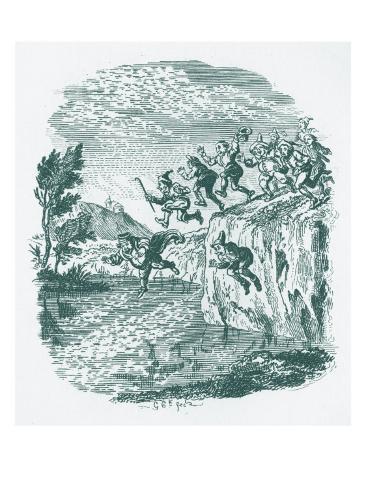 |
| Pee-Wit George Cruikshanks |
Discussion
Points
Well, put it this way,
I think it is safe to say that stereotypical fairy tale virtues such
as kindness, selflessness and honesty pretty much don't exist here.
This might not be new to many of you, but seeing as this is the first
time I’m reading any tales but the well known ones, I’m starting
to realize something surprising. Not all fairy tales hold by the same
morality code that;
a. We do
b. We expect these
educational stories to.
Basically, the reason
some virtues can be considered stereotypically the ones that fairy
tales try to pass on is because these are the ones our generation has
chosen to remember. We tell the stories that praise innocence, beauty
(both inside and out), purity, true love and goodness. But we
completely ignore the tales that praise completely different sorts of
virtues, such as intelligence, wit, creativity and self preservation.
Remember Hans, the nice, empty-headed boy who through is foolishness
ended up with nothing? Then there's the Wonderful Musician who
cruelly tricked the animals and still got his happy ending? And
what about that strange ending of 'The Turnip', where the youngest
brother tricks the unsuspecting student unnecessarily in order to
escape? In all these stories, the ones with a happy ending aren't the
ones who are nice- they're the ones who are smart and creative, even
if that means that they treat other people unfairly. The villains
here aren't evil- they're stupid. Basically, these tales run on a
completely different morality code than the ones we're used to, one
where the most important person is you rather than everyone around
you. It's alright to push others down in order to push yourself
forward. To make things easier, I’m going to call the first type of
tales the 'good' tales, and the second type the 'smart' tales.
Pee-Wit is a great
example to this. He as good as causes his own wife's death and then
uses it to further build his wealth. The most important thing to him
seems to be to make money, and the tale agrees with that and shows us
this by giving Pee-Wit his happy ending and making his enemies fail
and come out stupid. Pee-Wit does not seem to have a moral compass
that we today would agree with. He lies to get out of trouble, tricks
everyone around him for his own gain, plays with others' lives and
their deaths and would probably be on a few 'most wanted' lists if he
was alive today. And yet the tale seems to want us to take example
from this.
It's interesting to
note how Pee-Wit's journey begins; when he believes he is mocked, his life finally becomes too much for him and he takes matters into his own hands. This, I
think, may be the key to helping us accept the twisted morality that
continues throughout the tale, and through other 'smart' tales.
Pee-Wit starts off as a poor countryman. At the time the tale was
told, there were probably a lot of poor countrymen. It was a
different day and age where most the money and power was held by the
elite few while most people had almost nothing. In that day an age, a
tale where someone who had nothing manages to use his wits in order
to better his life was probably more important to some people than
tales of honest virtues and dependence on chance to change your fate.
Cinderella- type tales were always present as well, which gave
people two alternative ways to deal with the hardships of life;
a. You could be a good
person and hope that someone would consider you worthy enough to
grant you a chance at a better life. Most these tales involve an
element of magic: fairy godmothers, mysterious helpers, advice from
talking creatures, etc. Basically, they were more hopeful than
realistic. They told people that it didn't matter how bad your life
was, because being a good person is much more important.
b. You could take
matters into your own hands, try to change your own fate, use your
own personal skills to make a difference. While this option was much
more feasible, there is a price to pay: in the battle to help
yourself you will end up forgetting about everyone around you.
What would you choose?
Would you rather be a good, decent person or a successful one? The
answer might lead us to a speculation that could explain why the
'good' tales are more popular today than the 'smart' ones. In a world
where the rich and powerful are the ones who worked their way up to
the top and trampled on others to get there (rather than the ones who
were born to it), the 'smart' tales seem to have been a bit too
successful, with a very high cost. If our capitalistic lifestyle has
taken these types of tales a bit too seriously, doesn't it make sense
that we would try to balance that out by putting other virtues in the
spotlight? If everyone is so intent on being successful, there is no
longer a need for a tale that teaches us the need to be successful.
But we do need some stories to remind us that there are other things
that are important as well.
What do you think?

No comments:
Post a Comment