Now
this is a tale you shouldn't miss. I’m surprised I hadn't heard of
it before. It reminded me both of “Beauty and the Beast” and of
“East of the Sun and West of the Moon” and of the book inspired
by that tale “East” by Edith Pattou. While “The Lady and the
Lion” definitely has it's own story, perhaps the similarities to
well known tales are the reason most people haven't heard of it- it's
silly to introduce a tale which seems like a patchworks of others
already known and loved.

The
Tale:
The
story starts out very similar to Perrault's “Beauty and the
Beast”. A merchant with three daughters sets out on a journey and
asks each what gift they want him to bring back for them. The first
wishes for pearls and the second for jewels, but the third daughter
asks for a rose. The rose was the hardest gift for the merchant to
find because it was wintertime, but he loved his youngest daughter
the most, so he searched far and wide. At last he comes across a fine
castle, which had an enchanted garden. Half the garden was in winter
and the other half in summer. In the summer half, the merchant saw a
rose bush and immediately took one to return to his beloved
daughter. But lo and behold, as he was riding away, a fierce lion
jumped out at him and declared he would eat the thief who stole the
rose. The man begs and pleads until the lion agrees to spare the
merchant's life in return for the first thing that comes out to greet
the merchant on his return home. The merchant is unwilling to agree,
but at last decides that it might be merely a dog or a cat, and
leaves with his life and the rose.
As
I’m sure all of us have guessed so far, the first one who comes out
to meet him is none other
 than his youngest and favorite daughter. He
begins to weep and tells the girl of the bargain he had made and begs
her to stay. She decides that the promise must be fulfilled and tells
her father she will go to the lion and convince him not to eat her.
The next morning, she sets off with a bold heart. (Till here Beauty
and the Beast).
than his youngest and favorite daughter. He
begins to weep and tells the girl of the bargain he had made and begs
her to stay. She decides that the promise must be fulfilled and tells
her father she will go to the lion and convince him not to eat her.
The next morning, she sets off with a bold heart. (Till here Beauty
and the Beast).
Now,
it turns out that the lion is really (you're never going to believe
this) an enchanted prince who takes on his true form at night but
becomes a lion by day. The rest of his court also turn into lions
during the day (a much better fate than singing crockery, don't you
agree?). The prince greets the lady so courteously that she agrees to
marry him immediately. They get married at once, but the girl only
sees her husband at night- during the day, he roams off. Then, one
day, the lion/prince tells the girl her sister is getting married and
offers to have a lion lead her there if she wishes to go. Of course,
she goes and surprises everyone who had believed her eaten by the
dreadful lion. When the wedding feast is over, she returns to her
happy marriage life. Then it's time for the next sister to get
married, but this time the lady insists that her husband comes with
her. He refuses, claiming that even the smallest ray of light will
turn him into a dove and be obliged to wander for seven years until
he regained human form. The girl insists she will be careful and no
light will fall on him, but alas, despite their precautions, the
light hits the princes and he turns into a white dove. The girl
decides to follow her husband as he is forced to wander, and he drops
a white feather every once in a while, so she will be able to keep
track of him.
 |
She
follows him diligently for seven years, but towards the end, she
misses one of the feathers and looses track of the dove. She
immediately turns to the sun and the moon and asks them if they saw
the dove. They both reply that they have not, but give her a gift- a
casket and and egg- to open when she is of dire need. Then she asks
the same of the night wind, who refers her to the east and west wind,
and finally to the south wind, who had seen the dove. He had reached
the Red Sea and turned once more into a lion, where he was battling
an enchanted princess in the form of a dragon. The princess, of
course, wishes the separate the girl from her love. The night wind
then gives the girl council and tells her how to defeat the princess.
She does as she's told and breaks off the eleventh reed and smites
the dragon with it. Both she and the lion regain human form, but the
girl and the prince dally just long enough for the princess to whisk
the prince away.
Forsaken
and forlorn, the girl somehow finds the courage to decide that; “As
far as the wind blows, and so long as the cock crows, I will journey
on until I find him once again!”
At
last she arrives at the castle where the princess took the prince and
sees that a wedding feast is being prepared. The girls takes out the
casket the sun gave her and finds a beautiful dress which she manages
to trade with the princess in return for a visit to the bridegroom in
his chamber that evening. The princess tricks the girl and gives the
prince a sleeping draft so that when she comes to him, he is fast
asleep. The girl sits down next to her husband and says; “ I have
followed thee seven years; I have been to the sun, the moon and the
night wind, to seek thee; and at last I have helped thee to overcome
the dragon. Wilt thou then forget me quite?”
To
the sleeping prince, the words sound like the murmuring of the wind.
The
next day, the girl trades the moon's gifts- twelve golden chicks and
a hen that hatched from the egg- in order to see her husband the next
night as well. The princess decides to to drug the prince again, but
when the prince asks the chamberlain why the wind had “murmured so
in the night”, and the chamberlain tells him everything. The prince
then throws away the sleeping draught, and the girl comes and finds
him in a natural sleep. She tells him again “what woes had befallen
her and how faithful and true she had been to him”, and he wakes
up, remembering her voice. He tells her she has woken him from a
spell where he did not remember who she was, and the happy reunited
couple sneak away from the castle in the dead of night and return to
their home. Their they find their son, who has grown into a hansom
man these past seven years, and they all live happily ever after.
Discussion
Points:
Phew. Sorry for the
length of that. I'll try to keep the discussion points short.

I'll start this time
with the moral of the story, because other aspects of it interest me
more. There seem to be two main options- this story could either be
renamed “The Guide to Being a Perfect Wife” or “The Gide to
Perseverance”. I’m going to stick to the second, because in this
feministic age, some of the guiding points in the first are hard to
swallow. For the first option, the wife marries her husband to save
her father, brings out the best in her husband, bears him a son, and
follows him to the end of the world and back again while he gets
himself engaged to a princess. Basically, she gives up everything for
him and doesn't get much in return. She devotes her life to a very
needy enchanted man and serves him in everything.
The second option is a
lesson for everyone. It tells us how far you can go for
someone/something you care about. I can't help but admire the girl's
traits- she's brave, she's resourceful, she can see past faults and
she just doesn't give up. There were so many times she could have
given up, and yet she doesn't. She keeps going, on and on and on,
until she accomplishes her goal, and I think there is something all
of us can learn from this. There is another important lesson to learn as well; there is no need to completely destroy those who stand in your way to accomplish your goal in order for you to succeed. We see this very nicely when the girl and the prince sneak away in the dead of night and don't punish the princess as often happens in fairy tales (though admittedly, she was in more of a position of power than they were).
Now for things that I
found intersting in the tale:

Secondly, I love the
part when the girl asks for the help of the sun and the moon and the
winds. I think it's very poetic and beautiful, and truly signifies
how she accomplished the impossible. The sun and moon are so out of
reach, that in order for them to be her last hope, the only ones she
can turn to, her mission must be very difficult indeed. There is no
one else to turn to, so she turns to the masters of the sky, who are
always above her. It must have been very intimidating for her to turn
to them, but yet she did so, again and again.
As for the princess- I
feel as though this love triangle is very familiar. Many woman must
have lost their husbands to another. This story almost seems to try
and comfort them- the husband doesn't know what he is doing, he is
under an enchantment which is why he is with another, but he still
loves you, and you can get him back if you try hard enough.
Any thoughts on this
tale and (really long) post?
*I want to apologize for my irregular posting the past few weeks. Hopefully life will get more into routine next week, and I'll be able to post regularly again.
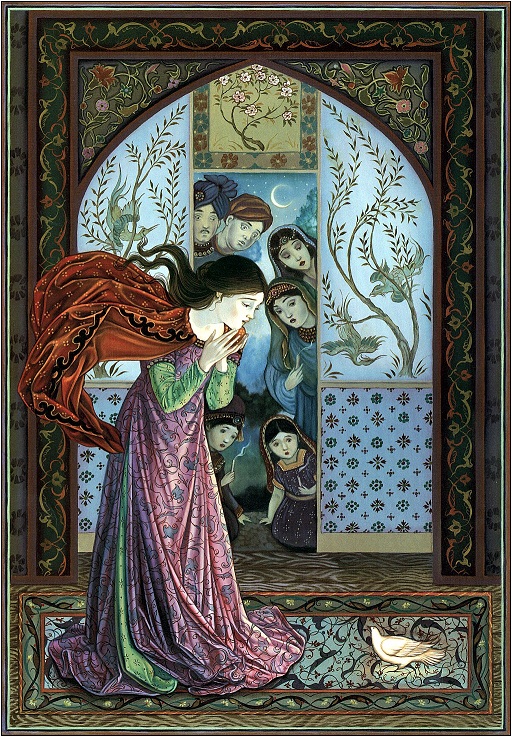
*All the illustrations are from "The Lady and the Lion: A Brother's Grimm Tale", illustrated by Laurel Lang.
*All the illustrations are from "The Lady and the Lion: A Brother's Grimm Tale", illustrated by Laurel Lang.

Considering I have just read 'Mrs Fox', this princess seems like a much nicer person (I'm not saying 'wife' because, like you, I think it is a tale of courage to fight for what you truly care about, rather than a wife enslaved by her husband. If she had been suffering in the role of 'good wife', I don't think she would have fought to follow him!)
ReplyDeleteThe links with Beauty and the Beast are fascinating, and one distinction that really stood out between the two is that in Beauty and the Beast, when the Beauty returns home she 'forgets' to return to the Beast. But the Lady here does not. She is not a girl torn between affections for/from her father and her husband, and not a flighty, unreliable fool who can keep a promise to one person (her father) and forget all about her convictions to another (when the Beast asks her to return home).
A very bizarre mish mash of stories, I'll definitely be looking into it more! Thank you for sharing, and for such interesting discussion points :)
I like your comparisons between Beauty and the Beast! It's hard not to like Lady more than Belle when you put it that way :)
DeleteIf you're interested, there's another tale that was very similar to this one so I decided not to post about it. It's called "The King of the Golden Mountain", and it's basically the male version of this story. It has lots of the same elements but has some very interesting differences. Here's a link: http://www.authorama.com/grimms-fairy-tales-53.html