I've
just skipped over quite a few tales in my book, some because they are
well known, such as “Twelve Dancing Princesses” and “Rose-Bud”
(Sleeping Beauty under a different name), and lots animal tales. I
have just done two animal tales in a row, and I feel the need to
write about human beings instead. I will hopefully go back to some of
them later, but for today I’m bringing you “The Queen Bee”, and
yes, it does involve animals as well, since there are precious few
tales that don't, but at least here the protagonists all have two
legs and the animals don't talk.
Apart
from that, “The Queen Bee” is one of the reasons I started this
blog. The moment I read it my head was buzzing with so many thoughts
that I felt the need to write them down and share them. I even have
the page dog-eared, because I was always planning to go back to it in
order to think about it some more.
This
is a rather more exciting (and typical) tale than the others have
been so far, with youngest sons and quests and princesses all around.
It is also very puzzling, as you will soon see.
I
think that's quite enough introduction for now. Let's get started!
 |
| "Queen Bee" Florida Center for Instructional Technology |
The
Tale
Two
king's sons left to make their way in the world, but fell into
wasteful ways of living, and so could not return. The youngest
brother, a “little insignificant dwarf” went to find them. When
he did, they laughed at him for thinking he would manage in the world
when they did not, them being so much wiser than him. All three
brothers set off and travel together. They reach an ant hill, a duck
pond and a bees' nest. The two older brothers want to kill the ants
for the fun of it, the ducks in order to eat them and the bees for
their honey. But each time the youngest brother stops them, telling
them to let the animals enjoy themselves.
The
brothers reach an empty castle where “they saw fine horses standing
there, but all were of marble and no man was to be seen”. They go
through all the rooms until they find one with three locks. They look
through a wicket and see an old man. They call to him, but he doesn't
hear them until the third try. Then he comes out to them and doesn't
say a word, merely leads them to a banquet table and after they eat
takes them each to a separate room. In the morning, he take the
eldest brother to a marble table and shows him three tablets which
explain how to disenchant a castle. The first one instructs the
eldest brother to find one thousand pearls belonging to the princess and scattered through the
woods by sunset. If one is missing, the
brother will be turned to stone. The eldest brother fails and is turned into stone. the second brother is given a go the next day, and he too does not succeed.
When
the dwarf's turn comes, he gives up pretty easily because the task
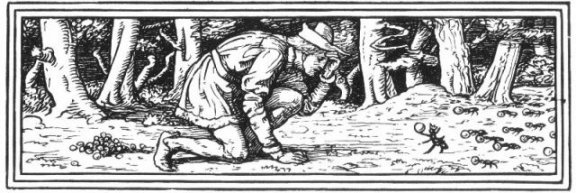
was hard and tiresome. While he cries, the ants he saved come to help
him and they quickly find all the pearls by nightfall.
The
dwarf moves on to the second tablet. The ducks he saved help him fish
out the key to the princess's bedchamber from the bottom of the lake.
In the third task, the dwarf has to choose the youngest and the best
of the king's three daughters. They all look identical, but one ate
sugar, the other hand syrup, and the youngest had honey. Now it's the
bee's turn to help the dwarf, and the Queen bee finds the princess
who ate the honey for the dwarf. The spell is broken and everyone who
was turned to stone is released. The dwarf marries the youngest
daughter and becomes the king's heir. The two older brothers marry
the two other princesses.
 |
| "Queen Bee" Walter Crane |
Discussion
Points:
There
are lots of things in this tale that don't make that much sense. What
did the brothers do that was so bad that they could not return to
their father, the king? Why aren't they ever described as princes? Why did the three brothers set out on a
journey together? What is with the three locks on the door, and why
doesn't the man hear them until the third time? Three is a very
common number in fairy tales, but it's usual use is to build suspense
or to compare the youngest to the failure of the older two. With the
lock and the man, this doesn't seem to be the case simply because they don't fulfill these goals. Who enchanted the castle, and who wanted the enchantment broken? Who exactly was turned to marble? If it is just the horses, why does the castle count as enchanted. If not, why are the king and the princesses not made of marble?
I feel like this tale would make an excellent retelling, just because of all the gaps there is to fill.
As
to the enchantment on the castle, while we don't have very many
details about it at all, I have a feeling it has something to do with
the third princess, since all the tasks seem to do with her (finding
the princess's pearls, the key to her room, and her). Also, I think
the old man is mute, since he never talks, only shows and leads. If
this is the case, he is the second crippled character in the story,
along with the dwarf.
The
Brothers: The story could be seen as showing a debate between two
kinds of people: those who see beauty, cleverness and strength as the
most important virtues, and those who see kindness, caring and
humbleness (in a way) as the more important. This is shown very
clearly by the three brothers. The older two stand by the first
opinion. They mock their dwarf brother for being young and simple in
comparison to their great wisdom and size. I think the matter of size is focused on more by the story itself than by the brothers, since
they never mention it. But the fact that the story describes the
youngest brother as a “little insignificant dwarf” says a lot. The
three princesses also seem to prove this point. They are all
identical in beauty, but the youngest is somehow the "best".
Whatever that means is up to you to decide. But once again, "best"
obviously isn't defined by "strongest and most beautiful".
The princess must have some other quality which makes her the best.
Perhaps she also kind, which is why she ends up marrying the dwarf
who shares the same quality.
 |
| "The Queen Bee Task" Salatrix Parvissima Grimm Fairy Tale Contest, Devianart |
The Dwarf: It's
very easy to see a comparison between the dwarf and the animals he
saves. For one, the brothers who mock him try to destroy the animals,
seeing them good for only one thing- entertainment or food, just like
they think their brother is good for nothing. But in the end, both
the dwarf and the animals prove their use. The animals aid the dwarf
and save him from turning into stone. The dwarf then saves his
brothers (with the help of the animals) from their fate and gets them
a happy ending. The dwarf has no other virtue of his own other than
kindness and compassion. He's not wise or brave or beautiful, as usual fairy tale heroes often are as well as kind. He goes to seek his other brothers, probably
because he cares for them and misses them and he saves the animals
from his brothers. But when faced with a difficult task, he gives up
and cries. His character isn't stereotypical or perfect. He has plenty of flaws. He is certainly not a knight in shining armor, but this is
the sort of story that says that knights can't accomplish everything. This
is, after all, a story about the strength of small, insignificant
creatures and the power of their kindness.
I
would like to point out two things before my ramblings are over:
1.
It's interesting that in most other stories that involves three
children, the father loves the third son dearly and is very reluctant
to let him leave. Here, the father isn't mentioned. I wonder if
perhaps if the dwarf had been a normal sized youth, the father figure
would have been there. On the other hand, the story starts
differently than most three brother tales. Instead of leaving one at
a time to a quest from the start, first the two brothers leave, and
then the dwarf comes to join them, which seems to highlight the
dwarf's insignificance. He wasn't invited to go on the great
adventure to explore the world along with the brothers, but he comes
anyway once they fail and joins them for a second try.
 |
| "Queen Bee Girls" Walter Crane |
2.
The first time I read this tale, I was very taken aback by the
ending. I didn't understand why the two older brothers had gotten a
reward as well. Perhaps they didn't deserve an unhappy ending, but
why should they too get to marry a princess? Once I thought about it
a bit more, the answer seemed obvious. They had, after all, listened
to the dwarf when he told them not to harm the creatures. They didn't
need to. The dwarf wasn't powerful enough in order to stop them
physically from doing as they wished. Nor did they hold him in
highest respect, so they really had no reason to listen to him. But
they did anyway, and I think that is the reason they got their
reward. I do quite like it that everyone got a happy ending. There
isn't a clear antagonist in the story, since we don't know who cast
the curse, and the brothers don't really count as antagonists. At the
end of the day, everyone was happy. Maybe that's another point this
tale tried to make. After all, true happiness is usually found in the
small things in life, and that's exactly what this tale celebrates.
The
Moral: I've said it a few times, but I'll try to say it a bit
clearer. I think this story comes to say that you don't need to be
born with certain traits in order to succeed and be a hero. You could
be flawed in every way- physically and mentally, but you can still be
a good person. You can be kind to others and care about them. You can
even get high in life, despite all the odds, succeed where others
have not and maybe even influence them despite the fact that they
seem smarter and better than you at everything.
*
For once I actually found the same version of the tale that I have
online, so here it is for anyone interested:

Great analyzing!
ReplyDeletePersonally, I think the young brother wasn't sent by the king to find the two brothers and didn't join the two brothers in the first place to emphasize his kindness. Nobody needed to push him into helping his two brothers, even though they are cruel and don't deserve his kindness.
Also, I wonder why this fairy tale is called "The Queen Bee" when obviously the Storyline itself is more focused on the three brothers and the comparison between them.
Thanks :)
ReplyDeleteThat's an interesting point. So him going out to find his brothers was an attempt to help them, and this shows his kindness because no one asked him to or told him to, or even wanted him to help them.
I think the tale is named after the Queen Bee and not after the brothers themselves because it most strongly emphasizes the tale's point. If all the animals represent the same idea the dwarf does, the idea that small ugly things can have merits of their own, then it would make sense that one of the animals would be in the title to symbolically present the idea. The bee is the creature that helps the dwarf on his hardest task (finding the princess). Also, bee are often viewed with fear because of their stingers, but they produce honey, which is sweet. I think the bee thus symbolizes the dwarf more than the other creatures, because of the two sided nature both share (the short, stupid, ugly dwarf is kind), while the duck and the ant are very much neutral.